It’s a shame that, with the amount of games on the AppStore, there really are very few development companies that can continually surprise and impress gamers with their releases. Granted, this number is starting to grow, and the future does look incredibly bright for iOS gaming, but we all know that that really depends on the market, and who can stick to their guns, deciding to not start making freemium IAP monger type games that are taking over the charts. I’ve felt this way for a while, but this week was an incredible week for iOS gamers, and has put a lot of that oomph back into our hearts. Aside from the best Action RPG to hit the iDevice, an amazing Physics-Puzzler, an incredible, and unique firefighting game, we received one of the most innovative, original and pure Puzzlers as well; Cipher Prime Studio’s Splice: Tree Of Life. If you’re into Puzzlers, Cipher Prime is responsible for the awesome iPad titles Pulse: Volume One [$2.99], Fractal: Make Blooms Not War [$4.99] and the iPhone game, Auditorium [FREE], each of which receiving great reviews with all but Fractal earning multiple awards.
With all of that in mind, our hopes and excitement for Splice: Tree Of Life was incredibly high, and after playing through the first couple levels of the game, once I started to understand the mechanics, I was hooked. There is no tutorial in Splice. There is a ‘?’ that can be tapped at any time during gameplay, containing 3 screens of instructions, but chances are, you’ll still need to mess around throughout the first world before you really get a handle on everything that’s going on.
The goal of Splice is to align microbes in the outlined pattern in the given amount of moves. In order to do this, you’ll need to drag-n-drop the misaligned microbes, attaching them to the one center microbe. Once you pick up a microbe, light grey outlines appear in places where you can attach it. If you don’t place it in one of those outlines, the microbe will jump back to where it originally was before you picked it up.
There are some microbes that have white symbols on them. These microbes, and sometimes, microbes attached under them, can be mutated depending on what symbol they contain. Some have an arrow that’s split in half, these can be mutated to split into two separate microbes, side-by-side, mutating all microbes connected under them as well. Another type has a regular arrow, and these mutate into two microbes as well, however, these mutate by splitting down so that the second microbe is directly under the original one, and these do not effect any microbes attached under them. There is also an ‘X’ symbol, which destroys that microbe, as well as any microbes attached beneath it. Once you hit World 6, you’re able to let microbes float. Here, the grey outlines don’t really matter, as you can place microbes out on their own. You’ll also come across stages where you’ll need to pull microbes that are out on their own into the design.
There are 49 original stages spread out across 7 ‘Sequences’ in Splice: Tree Of Life, with each stage called a ‘strand’. Once you complete these 49 strands, you’ll unlock the Epilogue. Here, there are 4 more Sequences, each with 7 more strands, for a total of 28 additional levels. These Epilogue levels are incredibly challenging, with fairly large strands to solve, using all of the mechanics from the original levels. Adding to this great challenge are ‘Angelic’ solutions. Each stage, having a certain number of moves available to complete the strand, has a potential ‘perfect’ solution, requiring less moves than that that are given. All of the levels are challenging enough, not to mention the insane difficulty increase when you move on to the Epilogue levels, but solving each and every stage with the Angelic solution should prove to be a challenge that not everyone can undertake. However, if you do get stuck and would like to know how to solve a particular strand, Cipher Prime’s website has posted all of the solutions via YouTube.
Like Cipher Prime’s previous releases, the graphics and atmosphere in Splice are phenomenal. The animations and movement for each microbe blends together seamlessly with the other microbes, as well as the movement of your fingers on the screen. This, combined with the beautiful soundtrack make for an incredibly immersive puzzler. You can also listen to and download the soundtrack on Cipher Prime’s bandcamp page, or check it out below.
GameCenter is supported, and includes 18 achievements (2 of which are hidden), which will only be unlocked by the best players. Unfortunately, there are no leaderboards, so competing with friends to see who can solve an entire Sequence the fastest will have to be done manually.
Priced at $3.99, Splice: Tree Of Life, is a steal. Awarded as the Best Puzzle Game of 2011 via the Intel Level Up Contest, and including hours upon hours of gameplay and mind-wrecking puzzles, it’s easily one of the best puzzlers available on any gaming platform. If you’re looking for a new and unique game that will provide you with an insane challenge, look no further. Cipher Prime has done an incredible job with the creation of this title, and I feel lucky to be able to have a port of it available in the AppStore, for a fraction of the PC/Mac Version’s price. Splice is a wonderful experience that should not be missed.
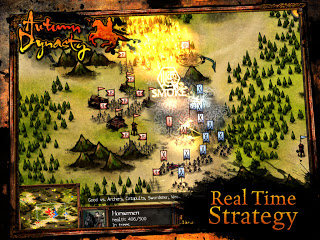
One of the best Real Time Strategy (RTS) games for the platform, Autumn Dynasty, has seen its first ever sale today (Thanks Bulkypix!) dropping its’ price from $6.99 to $2.99. Our ‘On Sale’ section is updated throughout the day with this information as well, but this game is just so awesome, I really wanted to alert you all as many places as I could!
I can’t say enough on how much this game rocks, and it has seen a few fabulous updates as of late which allows this game to be played as a casual pick-up and play, then save game, as well as game that you can sink massive amounts of time into. Something I still find myself doing, even with the plethora of new titles to the genre ever emerging. This is an iPad only game, but plays on all versions of the device.
Please check out our original review on this epic game for more information, or just do yourself favor if you are remotely interested in RTS games and hit that DL button!
The puzzle genre seems to be one of the most expansive genres of video games right now, reaching out and being merged with other genres and unique ideas week after week. Back in February, newcomer Fluttermind’s first iOS title, Incoboto, hit the AppStore, and gamers were exposed to one of the most unique, atmospheric and incredibly immersive action puzzlers to ever be released. And a couple of days ago, it was updated to include iPad 3 retina support, making it one of the most graphically stunning games available for the iOS.
Incoboto is the story of a little boy named Inco, living in a dying Universe, who awakes to find everyone he’s known dead and gone. Luckily, he’s not completely alone. That day, a sun named Helios approached Inco, saying he was hungry. Tired of staring off into space, watching the Universe die, they set off on their journey. Clues are left everywhere pushing him in the direction of The Corporation. The company who’s built, produced and basically rules everything, everywhere.
Movement is simple; touching on either side of the screen moves Inco in that direction, and tapping on the screen or swiping upwards causes Inco to jump. You’re also able to choose a joypad control scheme which gives you left/right buttons. Still, a tap or swipe upwards is required to jump. When you run into an object that can be fiddled with, read or picked up, a finger will appear above it, and to interact with it, you just need to tap under the finger. In order to drop an object, you tap Inco, to throw an object, you need to draw a line from Inco in the direction you want to throw, and to scan objects, you press two fingers down on both sides of the object.
Each level contains a certain amount of Starpieces, which you need to figure out how to collect so that you can feed them to Helios. Once you do, he will have enough power to open up the next Stargate so that you can progress to the next level. There are also 50 Star Charts lying around throughout the game, which you don’t need to collect, but collecting them all will get you a bonus at the end of the game.
Each world you come across will become progressively more difficult, with more and more objects, hazards, and gameplay mechanics being introduced almost every time you move forward. These include gravity beams, rotating planets, movable platforms, objects which require energy balls in order to run and loads more. The level design, and where all of the interactive objects are placed are fantastic, and very well thought out.
Graphically, the game is incredibly atmospheric, and combined with all of the clues and other text included in the game, creates a very gloomy and bittersweet environment. The lo-fi ambient music and sounds also help lend a hand to the game’s feeling, and perfectly complete the immersion provided by the gameplay.
With Incoboto priced at $3.99, it’s a steal, as it’s one of the must have titles available for the iPad. GameCenter is supported, and includes 12 achievements, but once you complete the game, there’s not much replay value there. However, the 6 or so hours it’ll take you to complete the game is 6 hours you won’t soon forget. Fluttermind has created an iOS classic with Incoboto, and if you’re even remotely interested in puzzle, adventure, or darker video games, this is one that you need to check out, and we, here at The App Shack, are eagerly awaiting to hear what Fluttermind will bring to the platform next.
iOS ports of games from other platforms are really hitting their stride. But Radiangames has very quickly become one of the top name developers in the dual stick shmup genre within the iOS scene. Porting over Fireball, Ballistic, Super Crossfire and Inferno from the XBOX Live Arcade, they’ve gained an even larger fan-base, and shown that an addiction to spheres can actually be quite healthy. But their most recent title, Slydris, is something totally different. And it’s great being able to see another side of the Radiangames team.
Slydris, originally released for the PC and MAC earlier this year, is a unique block-based puzzler that will have you just as hooked as their awesome DS Arcade shooters. Like Radiangames other titles, Slydris has multiple play modes; Infinite, Zen, and Survival, each offering up varied gameplay. However, the goal is always the same; Keep clearing lines by lining up and moving pieces.
Now, in Infinite Mode, you’re only able to move one piece at a time, which really puts the emphases on what piece you do decide to move. With blocks falling down from the top of the screen after every turn, as well as pieces moving up from the bottom every time you clear 5 lines after you clear 30, this emphases on which piece you move becomes even greater, because once a block is unable to fall from the top, it’s game over. The same rules apply to Zen Mode, you can move one piece at a time, except you don’t need to worry about making room for blocks. There’s no game over in this mode, and it’s more of either a ‘get comfortable with the gameplay’ or an ‘I just want to play with no added pressure’ mode.
In Survival Mode, it get a little trickier. You’re given a certain number of random lines while you’re unable to move any blocks. Once the lines are set, you’ll have about 5 seconds to move as many pieces as you can while trying to get rid of those lines. It quickly becomes pretty frantic , and is easily my favorite mode of play.
In each mode, there is a gauge on the right side of the screen which, when filled, gives you a bomb which you’re able to use to clear any 3 lines with. This really comes in handy, especially in the later levels when you’re looking at a game ending situation. Like in Tetris, every 10 lines you clear is counted as a level, and once you reach that level. Once you reach a level, you’re able to start every game from then on at that level, which, like Radiangames previous titles, eliminates a lot of the starting game boredom after you’ve gotten really comfortable with the game. Also similar to Tetris is the combo scoring system. As you complete lines, more blocks will be able to fall down into the nooks and crannies of your wall which has the potential to wind up knocking out more lines. The more lines you clear, the bigger your multiplier will wind up being, and the bigger the score.
Learning how to line up blocks so that they fall down, clearing more blocks is essential if you want to compete on the GameCenter leaderboards. And with boards for both Infinite and Survival Modes, as well as 16 achievements, there’s plenty of added replay value if you do decide to go score-chasing. Seeing this other side of Radiangames has given me a newfound appreciation for their titles. With as addictive, hectic and fun as their shooters are, Radiangames has captures that type of frantic feeling and injected it perfectly into this unique, and incredibly entertaining block-sliding puzzler. For $1.99, it’s a must have for puzzle fans, as well as anyone else who’s interested in seeing that Radiangames developers aren’t all orbs and spheres. I really hope to see them branch out like this more often with future releases.
Point & Click Adventure games have never really been a favorite of mine. Until lately. Bulkypix release, Yesterday and Cyan World’s realMyst definitely peaked my interest. But not until I had the extreme pleasure of experiencing Amanita Design’s amazing game, Machinarium, did I actually think that I could become a huge fan of Point n Click titles.
The first thing I noticed when starting up the game, was the fantastic graphics. The beautiful, amazing, mind-blowing, hand-drawn graphics are outstanding. And the way that the movable objects and computer graphics interact with the hand-drawn graphics is simply stunning. The animations are spectacular, and coupled with the music and sound effects, it all creates one incredible atmosphere, and portrays a great deal of emotion throughout the game. If you’re curious, the game is an exact port of the PC/MAC and PS 3 versions.
Starting off, your character, Josef, is tossed into a dump. You’ll need to collect pieces of your body before you can move on. As you’ll quickly realize, there is no dialogue, or long text to read through. Everything is portrayed in thought bubbles with action sequences. This leaves basically all of your gameplay time free for solving puzzles and exploring the environments, which you will do a lot of. Machinarium has your typical search and collect mechanics, but also has you solving puzzles across environmental areas, as well as combining inventory items and mini-games. But it’s all brought together in such an incredibly flowing motion, that you’re never taken out of the immersion of the game.
Now, I’ll quickly admit that I haven’t had the pleasure of playing many Point & Click games, but from what I have played, the puzzles that you need to complete in Machinarium are incredibly creative, and at times, can be fairly difficult to figure out, and some of them can seem downright unfair. Even with other titles within the puzzle genre, I’ve never come across this level of difficulty. However, not once did it become difficult to the point that it was frustrating. If anything, the difficulty ended up driving my addiction and love for the game every step of the way.
If it does get frustrating, there are actually two different hint systems available. Tapping the question-mark in a bubble will give you a pop-up thought bubble nudging you towards the next item you’ll need to pick up. The other hint system is a sort of walkthrough. You’ll need to first complete the mini-game in order to open the walkthrough ‘book’, and then each move that you need to make in order to complete the game is drawn out for you. However, going through all of this to get to the walkthrough is enough to keep you from going to it, and it does kind of ruin the game if you keep going to it over and over again. But it’s there if you need it, so there’s not going to be one spot where you get stuck and just end up not completing the game, which is great.
The story isn’t immediately clear when you start up the game, but as you progress, and find out that you’re not alone, and that this machine world is full of quite a few different robots and machine-beings, all with different personalities of their own, all expressed and conveyed in a way that everyone and anyone, no matter their past, cultural background, or language, can completely understand and feel comfortable with knowing what it going on with all of them. And as you progress, and get to know and help these other robots throughout the world, the story opens up, and your main objective becomes clear.
I can not recommend Machinarium enough. Especially if you’re a fan of Adventure or Point & Click games, but even if you’re not. This is one title that has a very good potential of turning you into a fan of the genre. Priced at $4.99, it’s an incredible buy. Not many iOS games even come close to being on the same graphical level, and there’s very few titles that come close to being as immersive and entertaining as Machinarium. It’s a must-own game for everyone who has an iPad, and I hope that Amanita Design decides to port over more of their titles to the iOS. We’d be lucky to have them available to us.
Endless games are a staple of the AppStore. Almost everyone has more than a handful of them, and even if you’re sick to death of all of the endless runner/climber/diver/jumper releases, chances are, there’s at least one or two (or ten) that will never leave your iDevice. Captain Antarctica, FDG’s newest release developed by Ideal Bureaucracy, might just wind up turning into one of those rare titles. At the moment, Captain Antarctica isn’t an Endless Runner, per say. It’s level based. But there is an endless mode coming in a future update.
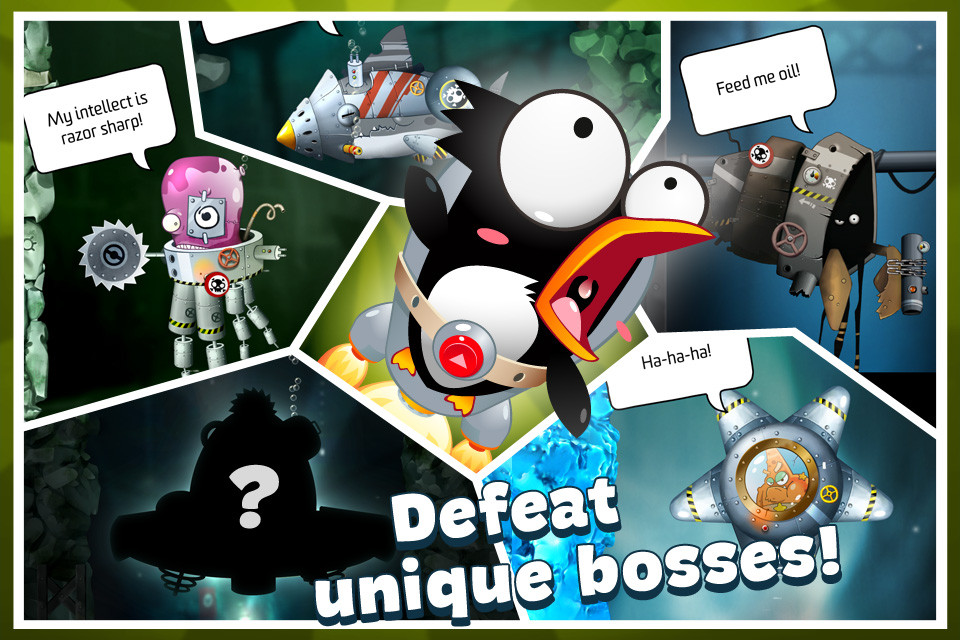
You’ll control Captain Antarctica, a penguin who’s on a mission to save his family. After his wife and children were kidnapped, Captain Antarctica decided to team up with a wacky scientist who’s invented an underwater jetpack suitable for a penguin to wear. Now it’s up to you to make your way through 6 different levels, each with a boss battle at the end, and manage to save your wife and kids.
Captain Antarctica is a diver. You’ll need to dive down into the depths of the ocean in order to defeat each level’s boss, and move onto the next one. Fortunately, these 6 levels will take multiple replays in order to beat the bosses. Each time you make it through the stage and down to the boss, you’ll be able to attack him once, knocking off a piece of armor, or injuring him. Also adding to the amount of times you’ll play through each level are objectives. These objectives help you earn coins which you can use to upgrade and buy equipment in the shop.
There are IAPs included in the game, but these are, like most games, only if you’d like to outfit your character with all of the best gear right when you get the game, or want to show your support for the developer, sending them a couple extra bucks.
In the shop, you’ll be able to purchase Utilities, including extra health, a better flashlight so that you can see better in the deep dark ocean, rescue buttons, which let you stay alive if you run out of health, and rush kits, which torpedo you down at light-speed. Bonus items are also available to be upgraded. You can increase your booster, upgrade your magnet, get a better shield, or upgrade your portal gun. There’s also cosmetic upgrades for your jet, you can purchase a trash can, flower, fruit, smiley, Soviet and more jets. Unfortunately, none of the jets increase your speed or agility, and are strictly cosmetic, though it would have been great if each of them had stats.

As you make your way through each level, you’ll be able to collect goldfish and various power-ups while avoiding the wall’s edges, sea urchins, fish, bombs, and other hazards. As you collect the goldfish, you’ll fill up your jet’s booster gauge, which will propel you down to the depths quicker once filled.
The graphics and animations are fairly polished, though having some better animations for when the penguin collides with objects, instead of just having him flash, and having explosions when you come into contact with bombs, would have been great. The comic strips however, look fantastic, and are one of the definite highlights of the game. The music and effects are a little cheesy, but they fit the game well.
Captain Antarctica is priced at $0.99 for the iPhone, and $1.99 for the iPad version. There’s not really a lot of content, but with the added objectives, and soon-to-come endless mode, it definitely has a chance of staying on your device for a while, especially if you’re interested in competing on the GameCenter Leaderboards for Total Coins Earned, and Total Distance Traveled. There’s also 32 achievements, adding quite a bit to the replay value. The addition of bosses at the end of the levels is great, and does kind of help the game stand out. However, not really being able to do battle with these bosses is a bit of a let-down. Having the penguin have to attack certain spots at a certain time would have been awesome. But there’s still enough here to keep endless gamer fans happy, and playing until they complete the game 100%. It’s definitely another nice FDG release. I can’t wait to see what they publish next.
Hex-based strategy games haven’t really been my cup of tea. New World Colony, Conquest!, Neuroshima Hex – none of them really did it for me, and with Neuroshima Hex being GameShark’s iOS GOTY, TouchGen’s runner up for Best Board Game, and a whole slew of fantastic reviews and press behind it, probably the ‘best of the best’ – I just figured the genre wasn’t really for me. Lucky for me, I was able to have an entirely different experience with Synaptic Wave’s (a 6 person outfit from the Ukraine, and developers of Tesla Wars and Tower Siege) Zombie Quest – Mastermind the Hexes!
Maybe it appeals to me because I’m not a hardcore strategy fanatic, maybe I’ve still got some ‘casual’ gamer left in me from my early 20’s, I dunno, but Zombie Quest really hit’s the mark between casual and hardcore which is usually a difficult balance to achieve for most strategy developing studios, who generally go completely casual, or full-on hardcore within the genre.
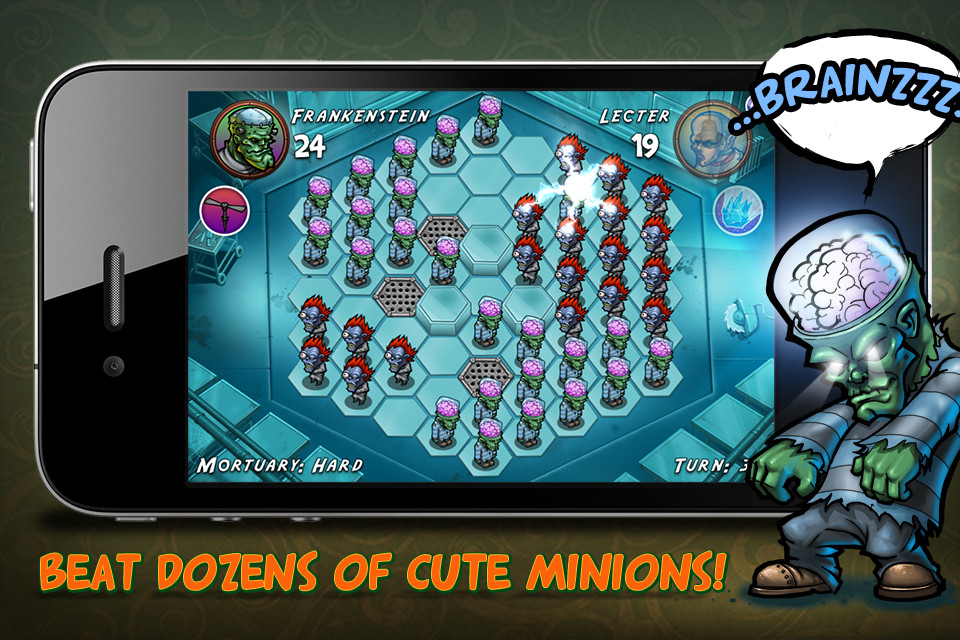
With Zombie Quest, you’ll be able to think your way through 5 different enemies, including Pinhead, Dracula, Lecter, Frankenstein and Torquemada, each having 4 different stages with increasing difficulty. The gameplay is simple enough, yet full of strategy. Whenever it’s your turn, you select one of your wolf characters on the screen, and you can either select a spot directly next to them, which will clone your character, and turn any enemy characters that are touching that spot into one of your characters, or you can jump up to 3 spaces away, not cloning your character, but sometimes being able to make it into a group of enemy tiles, resulting in a huge addition to your team. The side with the most characters on the board when there are no more moves left for one of the players, or the board is full, wins.
The addition of power-ups makes the gameplay even more strategic. At first, you’re only able to use a shield, protecting one of your wolfs from becoming an enemy if they move next to your character. The enemy is also given a power-up, in the case of your first enemy, Torquemada, he’s able to use a crane like power-up, removing one character from the board. Once you complete the 4 Torquemada stages, you’re given that power-up, and can use it throughout the rest of the game. Also adding to the game is a special 2 player, side-by-side mode, which lets you play with another player on the same device. With not too many 2-player-1-device games out there, it’s definitely a plus, and was a pretty big surprise to find included with the game.
It’s not really anything that hasn’t been done before, I’m sure, though I’ve never had the pleasure of playing a hex based strategy game that does what Zombie Quest does, with a surprising amount of polish on the animations and graphics, as well as casual gameplay that could easily appeal to hardcore strategy gamers looking for something to blow through, or take their mind off of extremely deathy gameplay.
Zombie Quest also includes GameCenter integration with a total score leader board, and 15 achievements, adding some replay value to the game, but if you’re not really a high-score chaser, or achievement fanatic, the 20 levels don’t really offer up much replay value, and will probably not be a game you dive back into time and time again after completion. However, the time you do spend making your way through the game will be toughly enjoyed, especially if you’re new to the genre, or more of a casual gamer.
With a few fairly deep strategy hex based games in the AppStore, games like Zombie Quest is something we could definitely use more of. If you’re looking for something with loads of depth, and endless replay value, chances are, this is not for you. But priced at $0.99 for the SD version and $1.99 for the HD version, it’s worth snagging if your interested in getting into the genre, are looking for another 2 player on 1 device title, or are interested in something that won’t push your mind to the edge through every stage of the game. With their previous Synaptic Wave releases, the updates have definitely not been in short supply. Hopefully Zombie Quest will get a couple more enemies to take on, or maybe even multiplayer in the future. With the gameplay, it’s easy to see multiple different routes being taken, and hopefully Synaptic Wave will take advantage of that.
The first stealth game I played on my first iOS device was Silent Swords. Since then, the stealth genre hasn’t really gained much ground in the AppStore. It’s not something fans of the genre aren’t use to, good stealth-based games don’t come along too often, and on the iDevice, we’ve only got a couple available to us. But thanks to Hassey Enterprises, developers of the iOS version of Galcon, we can add one more title to the list of so few; Dynamite Jack, a new iPad only stealth game where you control Jack, a captured space marine who was forced to work in the mines can only use bombs and a flashlight to escape.
Don’t get me wrong, there are many more items that Jack can use during his escape, but your two main resources are your flashlight, and an endless supply of bombs which you can use to break through walls, and destroy enemies. You’ll also need to find and collect keycards, data chips, crystals, and more while figuring out how to move through each section of the mines without being spotted.
There are two control setups in Dynamite Jack, a virtual joystick which can be fixed or float, and a line drawing option. If you’re more comfortable with the Spy Mouse or The Nightworld setup, you might want to use the line drawing controls, but for those of you who prefer it, the virtual joystick is a great option, even though it can be kind of finicky with movement, especially if you choose the floating joystick option. This can sometimes get frustrating when trying to quickly hide from guards or quickly place a bomb. With both control schemes, you’re also given icons for turning your flashlight on/off and placing + exploding your bombs.
You’ll have to be careful as to when you have your flashlight on, as it can draw the attention of the mine supervisors, and their only job? Shoot on sight. Not only do you need to be very cautious with your flashlight, but also your bomb placement. Since bombs also draw the attention of the supervisors/enemies, and you’re only able to place one bomb at a time, not being able to place another one until you set off the one you’ve already set, placing a bomb in the wrong spot can get you killed. You’ll need to figure out where exactly to place a bomb so that you can be far enough away, but also not be in the line of sight of the guards as they come over to inspect the loud boom they just heard, and maybe be able to place a bomb between them and their designated lookout area so that you can kill them on their way back to patrol.
What really stands out, aside from the fact that this is quite possibly the best stealth based game I’ve played on the iOS yet, is the fantastic level design. Needing to explore, and being forced to use your flashlight, even in the most inconvenient of times in order to figure out where to go, or how to reach a certain item is fantastic, and adds a ton of challenge and difficulty to the game.
With 28 levels, the game may seem short, but there’s plenty to do even after you’ve completed the game. Each stage has 3 objectives which are optional, but which add to the replay value, or, if you’re determined to snag them all the first time through, add a crazy challenge to the game. These objectives include beating levels in a certain amount of time, getting through levels without using your flashlight, collecting all of the crystals, leaving all of the guards unharmed, collecting all of the data cartridges, beating a level without dying, detonating a certain amount of bombs, and loads more.
Also adding to the replay value is GameCenter integration which includes 13 hard to unlock achievements. There’s also leader boards for speed run times on every level within the game. Here, you can go against your GameCenter friends times, as well as compete with players around the world. If that isn’t enough, there’s also a level editor, which lets you create levels, and community area, where you can share your levels as well as download maps from other players.
With Dynamite Jack priced at $2.99, and definitely standing out as one of the best stealth games available for the iOS, it’s a must buy for fans of the genre. I’d consider it the best if the controls were tightened up a bit. But even if you’re not into stealth games, Dynamite Jack provides a great challenge for casual and hardcore gamers alike, and is definitely recommended.
Castle Defense titles have become a great way to grab a few minutes of defense strategy gameplay while on the go, because of the AppStore. They’re great anywhere, appeal to a wide range of players, and hit that strategic nerve a lot of us gamers have without requiring us to play through a 2 hour game, or 45 minute level. While games like Stick and Cartoon Wars pioneered the genre on the iOS, games like Legendary Wars and the Fortune series pushed it more towards the hardcore strategy gamer, and that’s where Category 5 Games most recent title, Warmongers, fits in.
Warmongers is a single screen, 5 lane defense title, which requires quite a bit of strategy to progress through. While battling it out through hundreds of levels, you’ll be able to collect coins, unlock and upgrade characters, build up powers, and select special ability giving colors for your army.
Starting off, you’ll need to play through one area, with 3 stages. Each of these stages has 3 separate battles that you’ll need to complete in order to take over the area. Once you battle your way through all 9 stages, each getting progressively harder than the last, the territory is yours. As you make your way through the territories, more and more battles are required to play through before you take the territory over.
In order to win a battle, you need to get enough of your characters over to the enemies side. At the top of the screen is a gauge, starting with each side locked at the middle. Once you get a character over to the enemies side, your gauge takes over a little bit of the enemies gauge. If they get a character over to your side, the gauge moves back. To win the battle, you need to completely own the enemies gauge. Sometimes it can take less than a minute, others, it’s an all out epic battle, going back and forth, with each side almost winning multiple times. It all depends on what characters you send out, when you send them out, what power ups you use and when, and when you use your special color ability. With each character you send out costing mana, and only 200 mana available to you at any given time, it’s usually a struggle the whole battle.
In the shop, you’re able to upgrade your characters, powers and colors. With each character, you can upgrade their level, which increases their defense, speed, and attack, or increase their attack and defense separately. You’re also able to purchase Bloodlust abilities, which are special attacks that can be used when your bloodlust gauge is filled.
There are IAPs in the shop, and with no levels being able to be replayed for extra coinage, and the pretty high cost of upgrades and character unlocks, and the difficulty brought on by only having 200 mana available to you at any given time throughout the game (with characters mana costs being between 35 and 45) it can feel like the game is pushing you towards purchasing extra coins quite a bit. This is a shame, because everything else within the game is top-notch. Unfortunately, this push to purchase extra consumable IAPs after the original purchase of the game can be a real deal breaker for many gamers.
Right now, Warmongers is having a 50% off launching sale, and the iPhone version is priced at $0.99, with the HD version priced at $1.99. Considering it’s pushed towards purchasing extra coins through IAP, having a $1.99 and $3.99 title, and not being universal, it’s a hard game to recommend. But if you’re looking for a game that pushes you towards making certain upgrades without any experimentation, and loads of challenge, and high difficulty, then Warmongers is a strategy game you’ll most likely fall in love with.
Myst. For a lot of gamers the name conjures up great memories, fantastic gameplay, and one of the most innovative games of the 90’s. The first time I played Myst was in 1999 during my 3 free periods in High School. It took me about two weeks to complete the game, but it’s stuck with me after all these years. I had heard about a ‘realMyst’ which was done in a type of first-person gameplay incorporating free-roam, but I never got the chance to play it. Now, almost 20 years after it’s original release, realMyst has been ported over to the iOS, and I’ve been extremely excited to dive back into the game after all these years, being able to experience it in a new way.
If you’re new to Myst, it was originally a point and click puzzle adventure title done in a first person view that had you thrown onto an island and left the rest up to you. There was no tutorial, no one telling you where to go or what to do, you had to figure it all out on your own. There were clues left in notes around the island, and little clips found in books and strange machines that guide you along and give you backstory. It took me about 10 tries before I actually got into the game because I never knew what to do, until a friend told me where the first note was, and then I was off, totally immersed in the world, exploring the island through the different ‘ages’ solving puzzles, backtracking, gathering clues, and loving every minute of the gameplay.
The controls fit perfectly with the touch screen, dragging to look around, tapping and holding to move forward, doing a double tap and hold to sprint, and touching two fingers to the screen to move backwards. Everything within the game can be dragged or tapped to be activated, and like most other point & click games, feels like a perfect fit for the iDevice.
The graphics in realMyst are fantastic. The atmospheres and environments are beautifully crafted, and full of seemingly esoteric structures that eventually come to life before your eyes. Unfortunately, there are some notes within the game that are pretty blurry, and hard to read. There’s also some very noticeable drops in frame-rate and jitteriness while exploring the world. This does wind up knocking you out of the immersion a bit, but it doesn’t really harm the gameplay. Myst is not an action oriented game, no one is chasing you, and you’re not under a time limit to find clues so you’ll never die because you couldn’t move fast enough or because a couple frames were skipped. But it would be nice if there was a way to optimize the game, even at a drop in frame-rate, so that you’re not constantly reminded that you’re playing a game. But it’s easily one of the most graphically impressive games I’ve ever had the pleasure of experiencing. The music, ambience and sound effects are also just as fantastic as the graphics, and fit in perfectly with the settings, adding immensely to the atmosphere and feeling of the environments throughout the entire game.
It might take a while to actually get into the game, and figure out what to do in some parts, but the main thing is to keep at it, keep exploring, keep looking at everything, switching levers, touching books, pictures, and knobs, and you’ll slowly progress through one of the most amazing games to date, and find out why some gamers call Myst an experience that borders on being referred to as art more than a game. realMyst is only available for the iPad 2 and 3rd Generation iPad, and priced at $6.99 for launch, with the price set to go up to $9.99 soon. There is no GameCenter integration, which is kind of disappointing, as achievements for Myst would have been a wonderful addition, and would have added to the drive to really explore every little inch and crevice throughout the entire game.
If you’ve experienced Myst in the past, realMyst’s gameplay and feeling is different enough that it’s worth checking out again. If you’re new to Myst, realMyst is quite possibly the best version you could check out, and even at the regular price of $9.99, is more than worth every single penny you’d spend on it, even with the couple of issues within the game. Being able to have Myst on my iDevice is still pretty surreal, and I’m going to fully enjoy every single minute I spend exploring and solving the puzzles all over again. It’s definitely one game that every person who calls themselves a gamer should experience, and with this iOS port, it’s yet another opportunity to do just that.